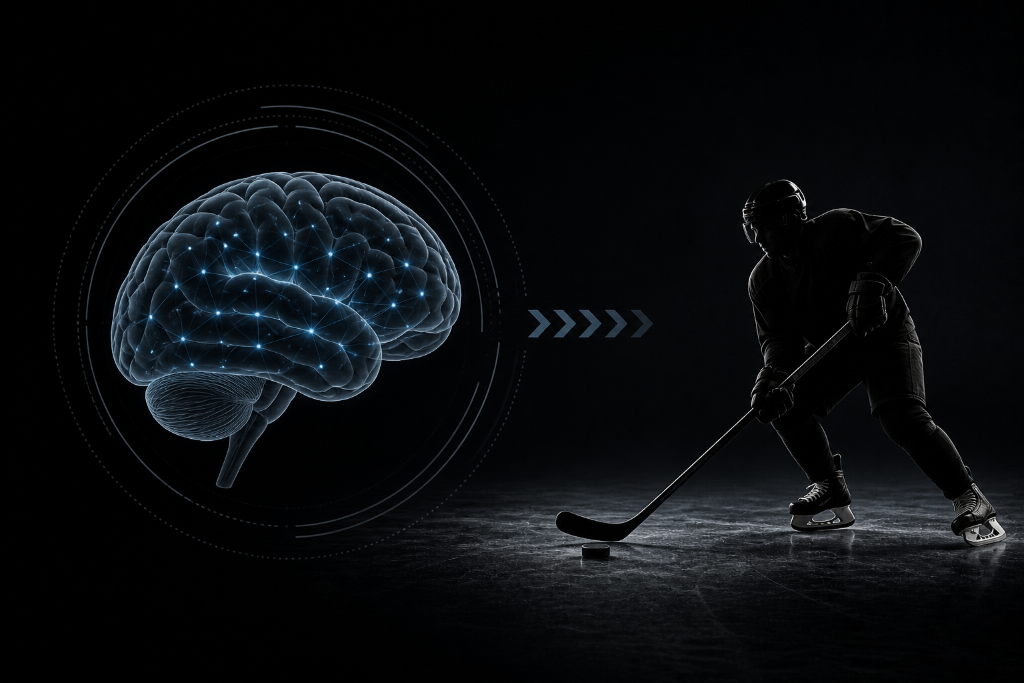
In a sport defined by milliseconds, the competitive edge is no longer found in a carbon-fibre stick or a custom skate blade.
It lives, quite literally, inside your skull.
As the 2026 season accelerates, a growing number of elite coaches, sports scientists, and NHL development programs are arriving at the same conclusion: the athlete who wins the cognitive battle wins the game.
Neurological training — once a closely guarded secret of the pro ranks — has arrived in full force. And it is reshaping how the game is taught, developed, and played.
Why Processing Speed Has Become the New Skating Speed
For decades, hockey development followed a familiar script: skate harder, shoot harder, lift heavier. The results were predictable. Athletes got faster, stronger, and more physically uniform.
The physical gap between elite and average players began to close.
The cognitive gap, however, did not.
Recent neuro-performance research reveals that elite junior players demonstrate measurably sharper N400 cognitive processing latencies than their peers — a technical way of saying their brains identify, interpret, and react to game stimuli faster than the competition.
The data behind this shift is hard to ignore:
-
The 60-Millisecond Edge. A 2025 study found that top-tier forwards hold, on average, a 60-millisecond advantage in auditory and visual processing over their peers. In a sport where pucks travel upward of 100 mph, that margin is the difference between a read and a reaction.
-
Fewer Turnovers, Better Decisions. Targeted cognitive training programs have demonstrated reductions in passing errors and turnovers of nearly 40 percent in high-speed game simulations — without a single on-ice rep.
-
A Quieter Case for Injury Prevention. Players with higher cognitive flexibility have been shown to anticipate blind-side contact earlier, allowing for subtle body adjustments that meaningfully reduce concussion risk.
The Tools Redefining Development in 2026
The Neurotech space has matured rapidly. Where early adopters were limited to reaction light boards and basic visual drills, today's athletes have access to clinically validated platforms that target the precise cognitive functions that drive elite performance.
Three tools have emerged as the industry standard.
1. NeuroTracker: Building the Hockey Brain's Spatial Map
Developed out of the University of Montreal, NeuroTracker uses 3D Multiple Object Tracking (3D-MOT) — a technique that forces athletes to maintain awareness of multiple moving targets simultaneously in a three-dimensional space.
The translation to hockey is direct. The tool trains the same mental faculty a defenceman uses to track a forechecker, the puck, and a breaking winger at the same time.
-
The Evidence: Players show measurable improvements in situational awareness in as little as 90 minutes of cumulative training time.
-
Why It Works: It doesn't replicate a hockey drill — it isolates and strengthens the underlying cognitive architecture that makes every hockey drill more effective.
→ View NeuroTracker Hockey Bundles
2. Reflexion: Training the Eyes to Find the Lane
Reflexion combines high-speed touch-screen platforms and virtual reality environments to benchmark two cognitive capacities that separate elite players from developing ones: Anticipation and Inhibition — the ability to act on the right read, and suppress the wrong one.
-
The Evidence: Users have reported a 20 percent improvement in peripheral target acquisition within the first month of consistent use.
-
Why It Works: The Reflexion platform replicates the sensory chaos of working in the slot — the moment when too much is happening at once and only the sharpest brain finds the open lane.
→ Explore Reflexion GO VR Systems
3. Neurable x HyperX: The Pre-Game Primer
Perhaps the most striking development in the Neurotech space is the emergence of consumer-grade Brain-Computer Interface (BCI) technology. The Neurable x HyperX headset — a 2026 breakthrough — tracks a player's real-time Focus Score and delivers neurofeedback designed to induce a pre-performance flow state before puck drop.
-
The Evidence: Neuro-priming protocols using BCI technology have been shown to reduce motor response time by approximately 40 milliseconds — a meaningful gain at any level of competition.
-
Why It Works: Most athletes take the ice flat. Cognitive priming ensures the nervous system is already operating at peak sensitivity when the opening whistle sounds.
How to Start: A Practical Entry Point
The barrier to entry is lower than most players assume. A structured introduction to neurological training requires no specialized facility — only intention and consistency.
Begin with 15-minute sessions, three times per week.
The principle is called Cognitive Loading: training the brain when it is fresh, so that when fatigue sets in during a third-period kill, the mental machinery continues to perform. The goal is not to exhaust the mind — it is to expand its ceiling.
The integration point matters, too. Pairing Neurotech sessions immediately before on-ice work has shown the strongest transfer of cognitive gains to game performance. Think of it as warming up the decision-making system before you warm up your legs.
The Bottom Line
The game has always rewarded the player who sees the ice better. For most of hockey's history, that was treated as a gift — something you either had or didn't.
The science now says otherwise.
Processing speed is trainable. Situational awareness is trainable. The anticipation that separates a good player from a great one is, increasingly, trainable.
If you aren't training your brain, you're playing a 2026 game with 2010 tools.