Hockey has a unique way of beating up the body.
You might only be on the ice for 45 seconds at a time, but those shifts are filled with acceleration, hard stops, crossovers, battles along the wall, blocked shots, awkward contact, and repeated bursts of near-max effort. By the time you peel your gear off after a game, your legs can feel heavy, your hips are tight, and your nervous system may still think you're midway through the third period.
That's why recovery shouldn't begin the morning after the game. Recovery starts when you step off the ice.
You don't need a laboratory, a dozen gadgets, or a two-hour routine. The best recovery plan is the one you can consistently follow.
1. Don't Go From Full Speed to Full Stop
One of the easiest mistakes is finishing a hard skate, sitting down in the dressing room, driving home, and calling it recovery.
Give your body a few minutes to come down gradually.
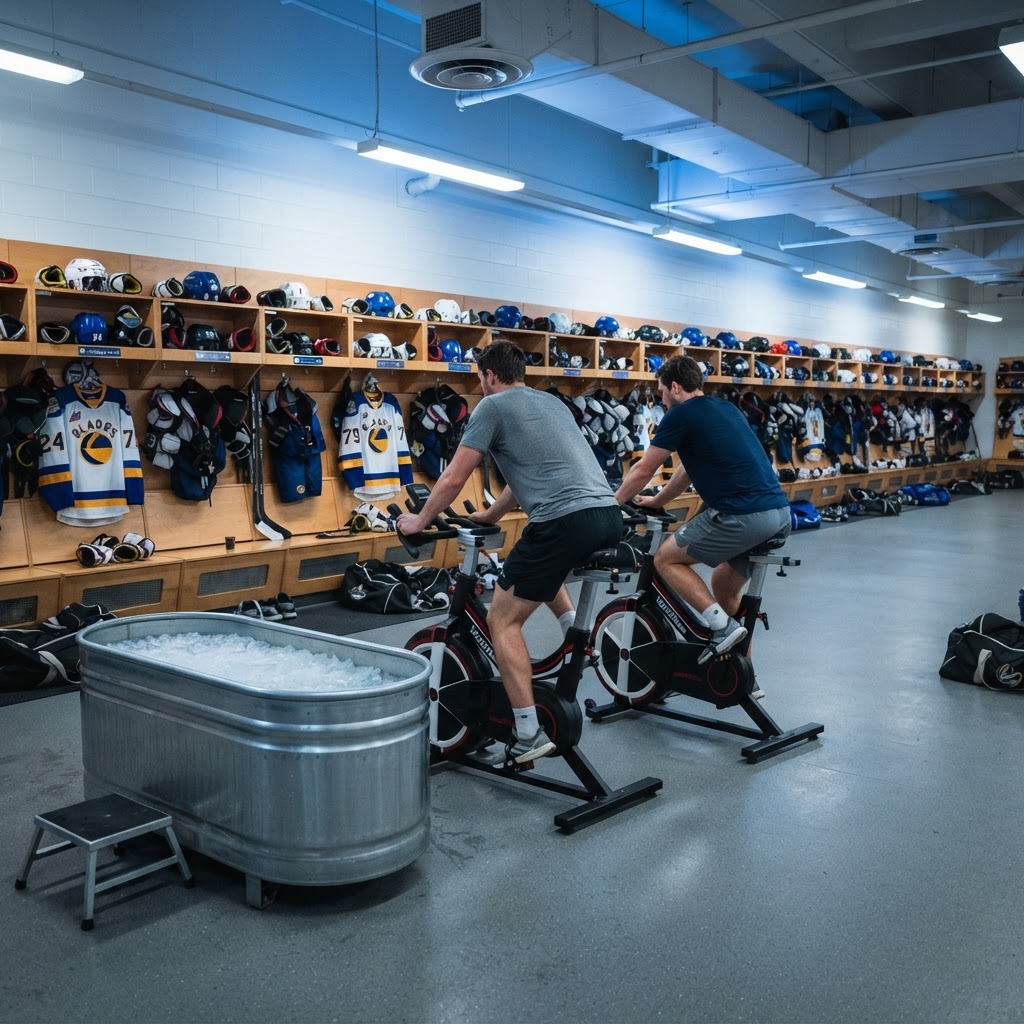
After a game or demanding workout, some light movement can help transition you out of competition mode. Walk around the rink, spend a few minutes on a stationary bike if one is available, or simply keep moving while you cool down.
The goal isn't another workout. It's the opposite.
You're telling your body: the game is over.
This can be particularly useful after games because hockey creates such a large contrast between high-intensity shifts and suddenly sitting still. Interestingly, a narrative review published in Sports Medicine by Dr. Bas Van Hooren and Dr. Jonathan Peake found that while active cool-downs don't dramatically reduce muscle soreness the way people assume, they do support a gentle return to baseline heart rate and circulation—and many athletes simply feel better doing them.
2. Rehydrate Before You Forget
Hockey players sweat more than they often realize.
Cold arenas can disguise how much fluid you're losing, and bulky equipment doesn't exactly help with temperature regulation. You may finish a game without feeling extremely thirsty while still having lost a meaningful amount of fluid. A study published in the International Journal of Sport Nutrition and Exercise Metabolism found that elite ice hockey players can lose well over a litre of sweat per game despite playing in a chilled environment, and many showed up to the next session still mildly dehydrated.
Start replacing it soon after the game.
Water is important, but after especially hard skates, tournaments, or back-to-back games, fluids containing electrolytes can also be useful. Sodium is particularly important because it helps replace what you've lost through sweat. The American College of Sports Medicine's position stand on exercise and fluid replacement recommends including sodium in rehydration fluids after heavy sweating, both to restore what was lost and to encourage you to keep drinking.
A simple rule: don't wait until bedtime to realize you barely drank anything after the game.
Keep a bottle with you when you leave the rink.
3. Your Post-Game Meal Actually Matters
That post-game burger may taste unbelievable, but your body is looking for something more specific.
Hockey burns through muscle glycogen—the stored carbohydrate your muscles use for high-intensity work. At the same time, training and competition create small amounts of muscle damage that your body needs protein to repair. Classic research from Dr. John Ivy's lab at the University of Texas showed that consuming carbohydrates shortly after exercise accelerates glycogen replenishment compared to waiting a couple of hours, and that adding protein can enhance that effect further.
That makes the recovery combination pretty straightforward:
Carbohydrates + protein + fluids.
Think chicken and rice, eggs and toast, Greek yogurt and fruit, a turkey sandwich, salmon and potatoes, or a smoothie containing fruit and a good protein source.
It doesn't need to be fancy.
If you finish a 10:30 p.m. beer-league game, you also don't need to force down a massive steak dinner at midnight. A lighter meal or recovery snack may make more sense if you're heading to bed soon afterward.
4. Give Your Hips Some Love
If there's one area hockey players should pay attention to after skating, it's the hips.
Our sport spends an enormous amount of time in a flexed skating position while repeatedly loading the hip flexors, glutes, groin, hamstrings, and lower back.
That's why the classic hockey-player walk after a tournament weekend looks the way it does. Research published in the American Journal of Sports Medicine by Timothy F. Tyler and colleagues identified reduced hip adductor strength and a lower adduction-to-abduction strength ratio as key risk factors for adductor muscle strains in professional hockey players—something that consistent mobility and strength work can directly address.
A short mobility session after you've cooled down—or later that evening—can help.
Focus on areas such as:
- Hip flexors
- Groin and adductors
- Glutes
- Hamstrings
- Calves and ankles
- Thoracic spine
You don't need to turn yourself into a yoga instructor. Five to ten minutes of easy mobility performed consistently is far more valuable than an elaborate routine you do once every three weeks.
And remember: mobility work shouldn't feel like another battle. You're trying to restore movement, not win a stretching contest.
5. Cold Therapy: Useful, but Not Mandatory
Few things feel better than cold therapy after getting banged around for three periods.
Cold plunges and ice baths can help some players feel less sore after intense competition, and they may be particularly useful during tournaments or stretches where rapid turnaround between games matters. A meta-analysis led by Dr. Jonathan Leeder and published in the British Journal of Sports Medicine found that cold water immersion reliably reduced athletes' perception of muscle soreness in the 24 hours after intense exercise compared to passive recovery.
But more isn't automatically better.
If your primary goal after strength training is building muscle and adaptation, immediately jumping into very cold water after every workout may not always be desirable. A study published in The Journal of Physiology by Dr. Llion Roberts and colleagues showed that regular cold water immersion after resistance training actually blunted long-term muscle hypertrophy and strength gains compared to an active warm-down. Cold exposure is better viewed as a recovery tool, not a requirement after every training session.
Game tonight and another game tomorrow? It may make sense.
Tuesday strength session with three days before your next skate? You probably don't need to sprint toward the nearest ice tub.
6. Compression, Massage and Recovery Gadgets
Massage guns, compression boots, foam rollers, massage chairs, and similar tools can all have a place.
The key word is place.
They can help you relax, reduce the perception of soreness, or make stiff muscles feel better. That can be valuable—especially after long bus rides, flights, or tournament weekends. A systematic review with meta-analysis published in Physiology & Behavior by Marqués-Jiménez and colleagues found that compression garments produced modest but consistent reductions in perceived muscle soreness and small improvements in the recovery of muscle power after strenuous exercise.
Just don't let the expensive recovery tool distract from the free stuff that matters more.
If you use compression boots for 45 minutes but sleep five hours and barely drink water, the boots aren't saving you.
7. Sleep Is Still the Franchise Player
If recovery had a first-line centre, it would be sleep.
This is when much of the repair and adaptation from training occurs, and it also plays an enormous role in reaction time, decision-making, mood, coordination, and overall performance. In a well-known study from Stanford University's sleep lab, researcher Dr. Cheri Mah and colleagues showed that extending sleep to roughly 10 hours per night measurably improved sprint times, shooting accuracy, and reaction time in varsity basketball players—findings that translate cleanly to a sport like hockey, where split-second decisions happen at full speed.
Those things matter in every sport.
They matter even more when you're trying to read a forecheck at full speed.
Late-night games make this difficult because your heart rate and adrenaline may still be elevated when you get home. Develop a simple post-game routine: eat something, hydrate, shower, dim the lights, get off your phone, and give yourself time to wind down.
You're not just recovering your legs.
You're recovering your brain.
8. Learn the Difference Between Soreness and Injury
Hockey players are famous for saying, "I'm good," when they are very clearly not good.
General muscle soreness after a hard game is normal. Sharp pain, significant swelling, instability, loss of strength, or pain that continually gets worse deserves more attention. Sports medicine research consistently emphasizes that delayed-onset muscle soreness peaks within 24–72 hours and resolves on its own, while the symptoms above are signs of injury that warrant professional assessment.
Recovery isn't about proving how tough you are.
It's about being able to play again.
The Hockey Recovery Checklist
After your next game, keep it simple:
Cool down. Rehydrate. Eat. Move your hips. Address soreness. Sleep. Repeat.
The flashy recovery methods can be useful, but they're the extras. The foundation is still nutrition, hydration, mobility, workload management, and quality sleep.
Do those consistently and you'll give yourself something every hockey player wants when the next puck drops:
fresh legs.