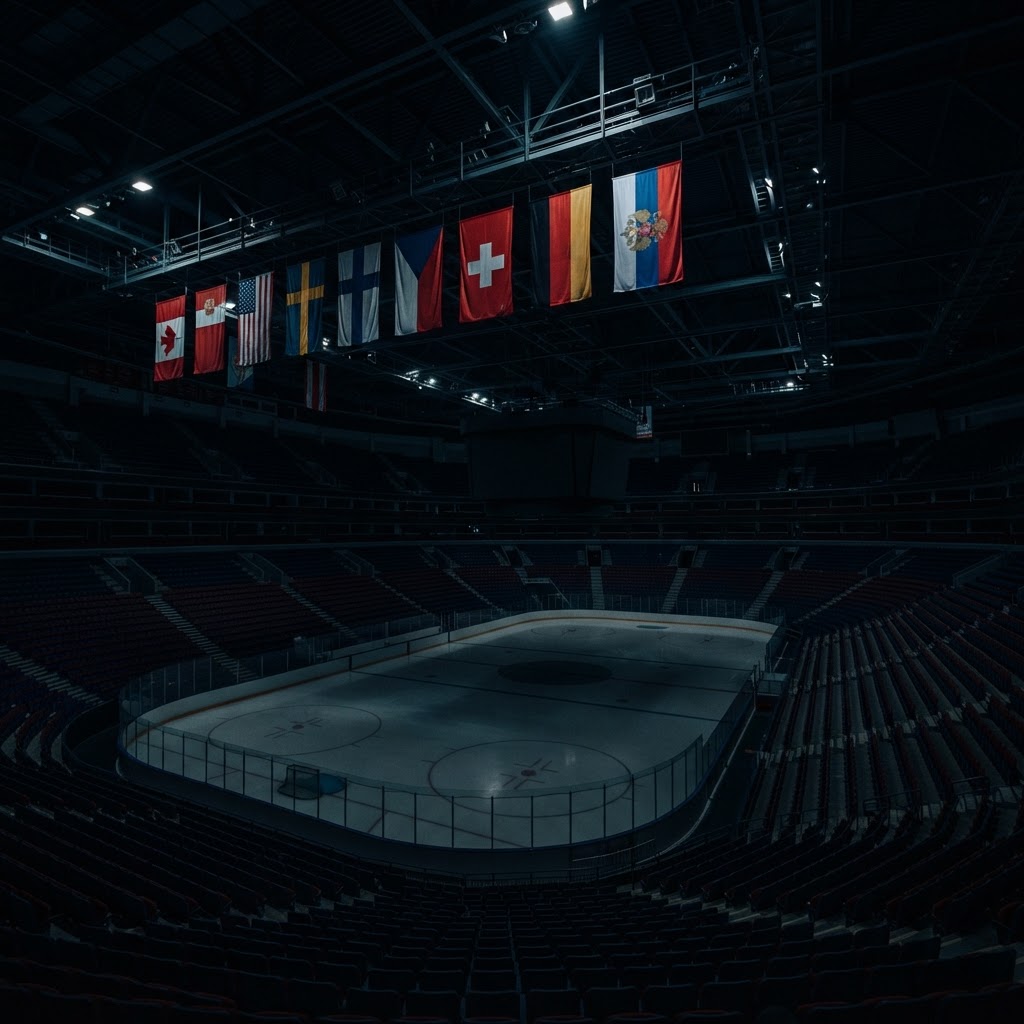
Some hockey arguments begin with a line combination. Others begin with a question that makes the entire room pause.
"When is Russia coming back?"
Fans can picture the matchups immediately. Ovechkin on a national roster again. A Russian power play running a 1-3-1 against a Canadian penalty kill. The kind of best-on-best hockey that only happens when every major hockey nation shows up.
But a tournament organizer has to picture something else: everyone arriving safely, games proceeding reliably, and a competition its participants can trust.
Where things stand
As of October 2026, there is no confirmed date for Russia's return to IIHF play.
The IIHF suspended Russian and Belarusian teams in February 2022 following Russia's invasion of Ukraine. Russia was also excluded from the 2026 Milano-Cortina Olympics, meaning the Games came and went without one of hockey's traditional powers on the ice.
The process shifted several times in 2026. In May, the IIHF Disciplinary Board annulled an earlier exclusion for the 2026–27 season, triggering a fresh event-by-event review. But on July 30, the Council excluded Russia from the 2027 men's World Championship, World Juniors, and U18 championships, citing "ongoing safety, security and sporting integrity concerns." Russia's eligibility for the 2027 women's World Championship was pushed to a November review.
The Russian federation announced it would appeal to the Court of Arbitration for Sport, calling the IIHF's position "shortsighted."
Key takeaway: "The decision was overturned" and "Russia is back" are not interchangeable statements.
The IIHF also has new leadership. In October, Franz Reindl was elected president, beating Czech candidate Petr Briza in a runoff. Reindl is a former Olympic bronze medallist with West Germany's 1976 squad and a past president of Team Europe at the NHL-run World Cup of Hockey. He has not yet publicly stated a position on Russia's reinstatement.
When heads of state start talking lineups
The Russia question has not stayed inside the IIHF boardroom. It has reached the level of heads of state.
In March 2025, during a phone call between US President Donald Trump and Russian President Vladimir Putin about the war in Ukraine, Putin proposed organizing hockey matches between American and Russian players — NHL versus KHL. According to the Kremlin's readout, Trump endorsed the idea. The White House did not immediately confirm the hockey discussion, but the proposal was widely reported and led to plans for a USA-Russia exhibition in Moscow, as well as the NHL including Russian stars on a "World Team" for its 2027 All-Star event.
That a phone call between two presidents about a war somehow landed on hockey tells you something about the sport's cultural weight in both countries. When political leaders start floating exhibition series, the line between sport and diplomacy gets blurry fast.
Canada's position has been more cautious. In July 2026, the Canadian government objected to the International Olympic Committee loosening restrictions on Russian athletes for the 2028 Los Angeles Olympics. Prime Minister Mark Carney has said Russia's ejection from international forums like the G7 and G20 was for "very valid reasons." No Canadian official has publicly pushed for Russia's hockey return.
The sporting case for a return
The argument starts with competitive completeness. Russia has won five IIHF World Championship titles as an independent nation. Removing a program of that calibre changes the field and eliminates matchups fans and players would otherwise anticipate.
Supporters also argue that athletes should not automatically carry responsibility for government decisions. That concern is hard to dismiss when discussing young players whose development years are passing while eligibility remains unresolved. A junior-aged player in 2022 would now be in his early twenties, having missed multiple World Junior Championships.
There is a further principle: if people cannot see what would permit a return, a temporary restriction starts to feel permanent.
None of those arguments requires minimizing the war. They ask whether sporting participation can be restored under workable conditions, and how individual opportunity should be weighed within a national-team system.
That is a serious position, not merely a fan wanting a stronger power play.
The case for continued exclusion
The counterargument starts with duty of care. A governing body is responsible for every delegation, official, and spectator involved — not just the quality of the roster lists.
There is also the experience of Ukrainian participants to consider. A tournament may be a sporting occasion, but the effects of war do not stop at the arena doors.
National-team competition carries national symbols and institutional representation, making it different from an individual Russian player working for an NHL franchise. It is possible to support an athlete's career while reaching a different conclusion about national-team participation.
The Universiade test case
The complications of a neutral return are not hypothetical. They are already playing out.
In September 2026, the International University Sports Federation included Russian and Belarusian hockey teams in the Winter Universiade 2027 in Changchun, China, under neutral status — no flag, no anthem. It is the first major international hockey tournament to readmit Russian teams since the 2022 suspension, and it has already produced a backlash.
On October 2, the Czech Ice Hockey Federation announced that its teams would not participate if Russian athletes are included, even under a neutral flag. If one federation boycotts, others may follow. If enough do, the tournament's integrity is compromised regardless of what the entry list says.
Removing a flag addresses part of the symbolism. It does not answer questions about acceptance by other participants.
What would a return mean for the game?
Fans would gain potential matchups and another important competitive storyline. Players would gain opportunities to measure themselves against opponents they have missed.
Organizers would face practical sporting questions: qualification, seeding, timing, and the treatment of teams already holding places. The next Men's World Championship is scheduled for Germany in May 2027. Those details should be settled through published rules rather than assuming another team can simply be moved aside.
Nor should Russia's absence become an asterisk automatically attached to everyone else's achievement. Teams can only compete against the eligible field, and winning those tournaments still requires excellent hockey.
A better question to ask
"When?" is understandable. "Under what conditions?" is more productive.
A credible path forward would explain how participation can be safe, how decisions are reviewed, and how the competitive consequences are handled fairly. The CAS appeal could force a legal reckoning, but arbitration does not resolve the underlying questions of safety and acceptance.
There is still a positive possibility here: international hockey can recover a major rivalry while protecting the people who make its tournaments possible. If that arrives, fans will have something much better than another argument to look forward to — a puck drop worth waiting for.